serhii.net
In the middle of the desert you can say anything you want
Title
Days
-
Kubernetes / Rancher much better way to copy data to PVCs
apiVersion: v1
kind: Pod
metadata:
  name: temp-pod
  namespace: CHANGEME-ns
spec:
  restartPolicy: Never
  containers:
    - name: temp-pod
      image: alpine:latest # Use a lightweight image
      command: ["sleep", "3600"] # Keep the pod running for 1 hour
      volumeMounts: # Mount the persistent volume
        - name: data
          mountPath: /data
  volumes: # Specify the persistent volume claim
    - name: data
      persistentVolumeClaim:
        claimName: CHANGEME-pvc
So basically trivial temporary pod done specifically to copy stuff to a PVC that auto-kills itself in 1h w/ no need to do anything for this — ty KM for this!1
Then one can happily copy stuff from there using the usual:
❯ kubectl cp CHANGEME-ns/temp-pod:/data/project/train7/ .
# as well as
kubectl exec -it temp-pod -n CHANGEME-ns -- sh
ADDITIONALLY, I had issues
cping things larger than 6gb. Reminder to myself that one cantarthings or just transfer in separate parts.
-
See also 240131-1535 Setup for Dockerfiles where you can look around before running for an overkill option for this that I wouldn’t use anymore ever. ↩︎
-
-
Rice
Good enough: How to cook white rice - easily and perfectly - RecipeTin Eats
TL;DR:
- don’t rinse
- 1 rice + 1.5 water, bring to a boil over medium high, no lid
- turn heat down to low, cover with lid, leave fo r13 mins
- remove from fire, lid on, wait for 10 mins
-
Підсумки 2024
Now playing: Кость Москалець - Віфлеєм; La Boheme - Freni, Pavarotti - G. Puccini (1995)1
Досягнення року: Eval-UA-tion; вело-тур 200+ км
Настрій року: Low-key напруженості
Зустріч року: DB
Подія року: велотур, який відкрив в мені любов до гамака та вузлів
Жах року: геноцид в Газі і реакція світу на це; вибори (в США і не тільки)
Країна року: Хорватія
Антилюдина року: Путін; дуже сподіваюсь, наступного року буде не Трамп
Місто року: Турин; Kozino
Слово року: Evaluation; (3D)Slicer; гамак; Tischtennis
Подорож року: LREC-2024 в Турині! Хорватія, Франція, вело-тур.
Веб-сервіс року: ChatGPT; Z-Library; Stremio; Infinite Flight
(Анти-веб-сервіс року: QIS)
Колір року: коричневий з золото-жовтими жилами/вкрапленнями (як мрамор)
Запах року: чаю “Turkish Earl Grey”
Новина року: TODO
Книга року: “Банальність зла” Hannah Arendt; “The Ultimate Hang” (Derek Hansen); “Fall; or Dodge in Hell” Neal Stephenson; “Nuclear War” (Anne Jacobsen); Stephen King’s IT; Glucose Revolution. Виявляється досить багато читав цього року
Фільм/серіал року: Star Trek Lower Decks; White Collar; Documentary Now!
Media N.O.S.: Fall of Civilizations podcast! Bob Gymlan; KyotoRobato; CITeam
Пісня року: Men at Work “Down Under”; “Я помру від застуди” (Мертвий Півень)
Заклад року: телевізор в спальні
Напій року: Чай який “суп”
Їжа року: “сира” яєчня, червона паста, суші; овочі перед їжою!2
Транспорт року: велосипед безумовно!Побажання собі на
201320142015201620172018201920202021202220232024рік:
Щоб всі були здорові і не було причин за них нервувати; щоб мобілізували не більше двох близьких знайомих; щоб взагалі було менше причин нервувати, і щоб я краще сприймав нерви навколо мене.Ціль на наступний рік: TODO
Ну і вічнозелене: Продовжити сон, спорт, медитацію – ЦЕ ПРАЦЮЄ. (x8)
(У)
-
Компот а ля АП
-
Мілко нарізані, “так, щоб не було противно їсти”
- Яблуко, нарізане спочатку а ля кавун, потім ще їх
- Випадкові фрукти, ягоди, все
- заморожені ягоди пачка ВСЯ
- ~7 слив
- ~7 абрикос
- 5 десертних ложек цукру, ~50g
-
Вода
-
Довести на середньому вогні до кипіння, без кришки
-
як тільки почне починати закипати (95C+) додати цукор
-
дати закипіти (сильно прям)
-
виключити вогонь, накрити кришкою, дати стояти до ранку
-
-
Packing for bike trip notes
-
Resources:
- How we pack our gear 1
- Packing Hacks for an Inexpensive Tour - Adventure Cycling Association2
- Terminology:
- resources:
- relevant for me
- seat pack = werkzeug Satteltasche
- frame pack = Rahmentasche
- rear rack (where baskets. etc. go)
- front/rear panniers
-
Order / strategy
- No backpack (or as little as possible in it)1
- helps for long rides
- Balance
- water:
- on top:
- things needed first when arriving at campsite
- No backpack (or as little as possible in it)1
-
Items
- Hacks
- Lists
- Touring Gear Essentials - Adventure Cycling Association (most links broken bit is complete)
- Hardcore
-
Food and stuff
- water: 0.5-1L / h
- 1L/h if it’s hot
- carbs: 30-60g / h
- up to 90 some say
- water: 0.5-1L / h
-
-
Naming conference rooms in your company after the illnesses you cure
TIL about a company naming conference rooms after the illnesses their product(s) cure — so e.g. a conference room “Depression” exists.
Damn I want to use this in some novel or short story I’ll write 20 years from now
-
A quick historical primer on the Ukrainian language
Copypasting this (still draft version) here in full, before radically shortening it for my master thesis.
Historical context and bilingualism in the modern Ukrainian language
L’Ukraine a toujours aspiré à être libre
“Ukraine has always aspired to be free.” Voltaire, 1731 1This section describes the bilingual nature of Ukraine’s society and the impact of historical state policies on the modern development of the language.
The ongoing Russian invasion is viewed by many as a continuation of a long-standing historical pattern, rather than an isolated incident.
This section doesn’t attempt to justify or challenge any particular position regarding the events described, nor is meant to be a definitive account of the history of the language.
But I believe this perspective is important to understanding the current linguistic landscape in Ukraine, as well as the linguistic challenges and phenomena that had a direct relevance on this thesis. (TODO mention how and which tasks are impacted by this)
A historical overview
- todo: more synonyms for ‘policy’
- todo: better title
- todo: sources for everything-everything-everything
- sources
- 1987 book about the entire topic [^@krawchenko1987social]
- Article The Executed Renaissance: The Book that Saved Ukrainian Literature from Soviet Oblivion | Article | Culture.pl
- Keeping a record is the best book on this [^@1130282272476965120]
In Ukraine itself, the status of Ukrainian (its only official language) varies widely, but for a large part of Ukrainians the question was never too much on the foreground (until recently, that is).
A significant number of people in Ukraine are bilingual (Ukrainian and Russian languages), and almost everyone can understand both Russian and Ukrainian.2
The reasons for this include Ukraine’s geographical and cultural proximity to Russia, and was to a large extent a result of consistent policy first of the Russian empire and the Soviet Union.The suppression of Ukrainian in the Russian Empire
In the Russian Empire, the broader imperial ideology sought to assimilate various ethnicities into a single Russian identity (with Russian as dominant language), and policies aimed at diminshing Ukrainian national self-consciousness were a facet of that3. TODO source
Ukrainian (then officially called little Russian language/малорусский язык) was stigmatized as a (uncultured town folks’) dialect of Russian, unsuited for ‘serious’ literature or poetry — as opposed to the great Russian language (not editorializing, it was literally called that; these phrasing applied to the names of ethnicities as well, Russia as great Russia and Ukraine as little Russia; the extent to which this referred broader cultural attitudes is a discussion out of scope of this Thesis). (TODO footnote to ‘War and Punishment’ for more on this)
The history of Ukrainian language bans is long enough to merit a Wikipedia page itemizing all the attempts, 4 with the more notable ones in the Russian Empire being the 1863 Valuev Circular (forbidding the use of Ukrainian in religious and educational printed literature) and the Ems Ukaz, a decree by Emperor Alexander II banning the use of the Ukrainian language in print (except for reprinting old documents), forbidding the import of Ukrainian publications and the staging of plays or lectures in Ukrainian (1876). (TODO sources for both)
The redefinition of Ukrainian in the Soviet Union
- TODO [^@marshall2002post] has many sources for this! The first decade of Soviet Union brought Ukrainisation as part of a new Soviet nationalities policy, and the use of Ukrainian in different areas was promoted. The reason for this was chiefly ideological — the ghosts of the old empire were considered a danger and encouraging formerly-suppressed cultures was one way to fight them — but nevertheless, this period led to a short-lived period of flourishing for Ukrainian literature and culture in general.
The 1928 grammar reform (sometimes called Skrypnykivka after the minister of education Skrypnyk) passed during this period, drafted by a commitee of prominent Ukrainian linguists, writers, and teachers synthetized the different dialects into a single orthography to be used across the entire territory.
The Ukrainian writers and intellectuals of that period became known as “the executed Renaissance”: most of them were purged in the years to follow, after the Soviet Union took a sharp turn towards Russification in the late 1920s and in the multiple waves of purges that followed. (Most prominent members of committee behind Skrypnykivka were repressed as well; Skrypnyk himself committed suicide in 1933.)
A new ‘orthographic’ reform was drafted in 1933. It had the stated goal of removing alleged burgeoise influences of the previous one. Andriy Khvylia5, the chairman of the new Orthography Commission described in his 1933 book “Eradicate, Destroy the Roots of Ukrainian Nationalism on the Linguistic Front” (TODO source) how the new reform eliminates all “deadly conservative norms established by nationalists” that “focused the Ukrainian language on the Polish and Czech borgeois cultures (…) and set a barrier between the Ukrainian and Russian language”.
In practice the reform brought the Ukrainian language much closer to Russian in many ways:
- Grammatically, by introducing relatively major changes in declension paradigms, plurals, especially targeting grammatical structures absent in Russian. The letter ґ (absent in the Russian alphabet) was dropped.
- Changes in the vocabulary were also massive: the spelling of foreign-derived words and proper names were changed to fit Russian patterns. For example, the German diphthong ei (IPA: [aɪ], approx. English “eye”), in Ukrainian ай with the same sound, became the Russian ей (IPA: [ɛj], approx. in English “they”), changing surnames like Einstein / Айнштайн (IPA: [ˈajnʃtajn])[^44] to Ейнштейн (IPA: [ˈɛjnʃtɛjn]). Genders of words were changed.
- Terminology: there was an effort to eliminate Ukrainian-specific vocabulary, much of which was just replaced with the (sometimes completely different) Russian equivalents. This was quite explicit, to the point that publishing houses regularly received lists of words to avoid. This increased the dependence of Ukrainian on Russian science.
Many Ukrainian writers, poets and dissidents kept using the ‘old’ orthography, as well as the Ukrainian community outside the Soviet Union.
After the fall of the Soviet Union, there were many proposals for restoring the original orthography, but only the letter ґ was restored. In 2019 a new version of the Ukrainian orthography was approved, which restored some of the original rules as ’legal’ variants but without mandating any of them.
-
TODO format citation Debunking the myth of a divided Ukraine - Atlantic Council citing Oeuvres complètes de Voltaire - Voltaire - Google Books ↩︎
-
While the two languages are mutually intelligible to a large extent, knowing one doesn’t automatically make understand the other - most Russians can’t understand Ukrainian nearly as well as Ukrainians undestand the Russian language, for example. ↩︎
-
(by no means the only one — but the stories of other victims of Russia’s imperialism are best told elsewhere, and for many ethnicities, especially ones deeper inside Russia’s borders, there’s no one left to tell the story) ↩︎
-
Later repressed for nationalism. ↩︎
-
LaTeX best practices and compression
Use 260330-1938 LaTeX paper final checklist at the end!
- References
EDIT: this is becoming a more generic thingy for everything I’d ever need to refer to when writing a paper, TODO clean this at some point.
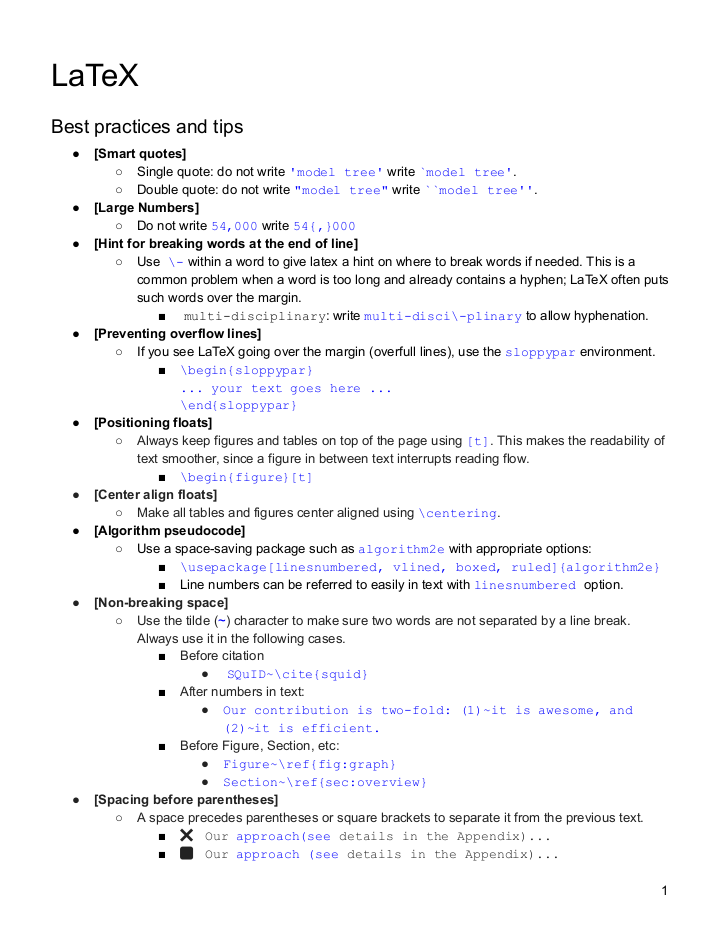
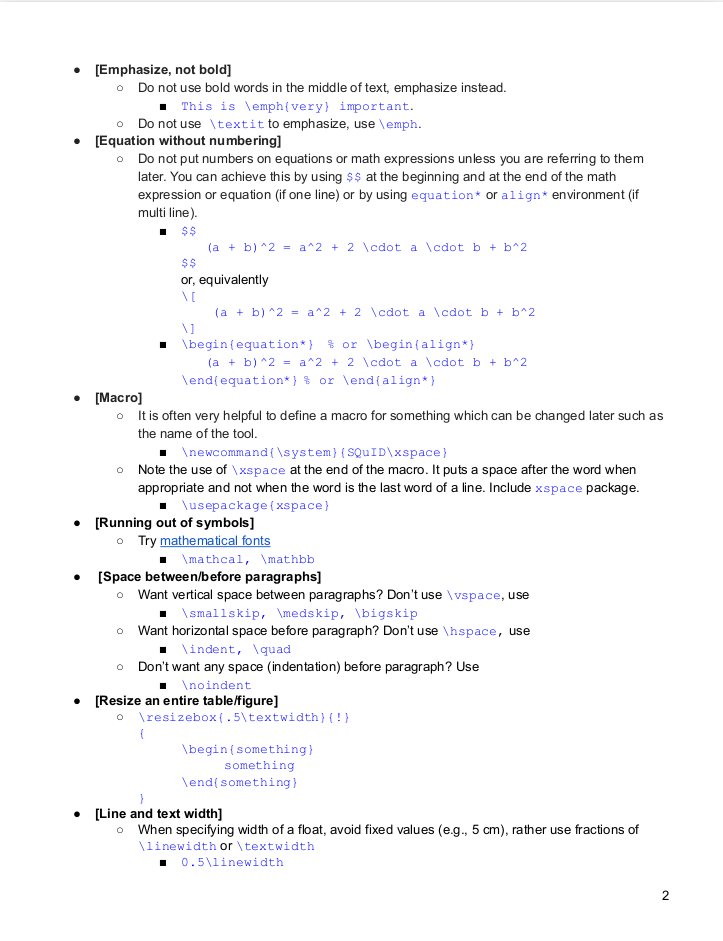
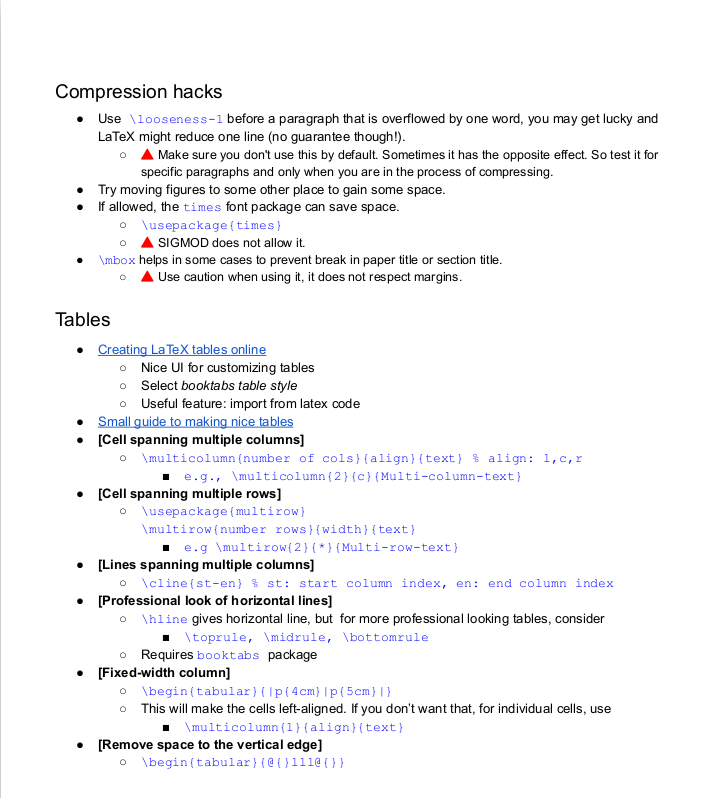
Resources – DREAM Lab links to https://dream.cs.umass.edu/wp-content/uploads/2020/04/Tips-and-Best-Practices.pdf. Until I set up a system to save PDF info, I’ll paste it as screenshots here:
ChatGPT summarized the relevant pages of the PDF file thus, but didn’t do it well, mostly rewriting myself:
General Formatting
\emph{}is better than\textit{}always, and supports nesting.- Smart Quotes: Use `x’ and ``x’’ for single and double quotes respectively.
- Large Numbers: Write large numbers as 54{,}000.
- Word Breaking: Use - to suggest hyphenation points in long words, including ones that already have hyphens inside them. Such words are likely to go over margins etc.:
multi-discipli\-nary - Overflow Lines:
\begin{sloppypar}...for paragraphs where latex goes over the margin. - Float Positioning: Place figures and tables at the top of the page for readability:
\begin{figure}[t] - Center Align Floats: Use
\centeringfor aligning tables and figures.
Specific Elements
- Non-Breaking Space: Use the tilde (~) to keep words together, including always
- before citations:
sth~\cite{whatever} - after numbers in text
- before figure/section references
- before citations:
- Emphasize vs. Bold: Prefer
\emphover bold or\textit.
Macros
- Macros: Create macros for things that will be changed later, such as DATASET NAMES, or things tedious to type like MODEL NAMES .
\newcommand{\system}{SQuID\xspace}for auto-space\xspaceguesses whether to add a space or not,\usepackage{xspace}. May fail in unexpected places.- Explicit is always better:
\system{}or\system\manually adds a space.
\newcommand{\llama}{Llama-3.3-70B-Instruct}
\newcommand{\mistral}{Mistral-Small-3.1-24B-Instruct-2503}

Two models, \llama{} and \mistral. % note spacing!
Spacing and Sizing
- Paragraph Spacing: Use
\smallskip,\medskip, and\bigskip, instead of\vspace - Line and Text Width: Use fractions of
\linewidthor\textwidth. - Resizing Tables/Figures: Use
\resizeboxwith appropriate dimensions.
Compression hacks
- (see pictures)
- Make spaces smaller around lists:
\begin{itemize} \setlength{\itemsep}{0pt} \setlength{\parskip}{0pt}huggingface.cocan becomehf.coin footnotes!
Paper writing hacks
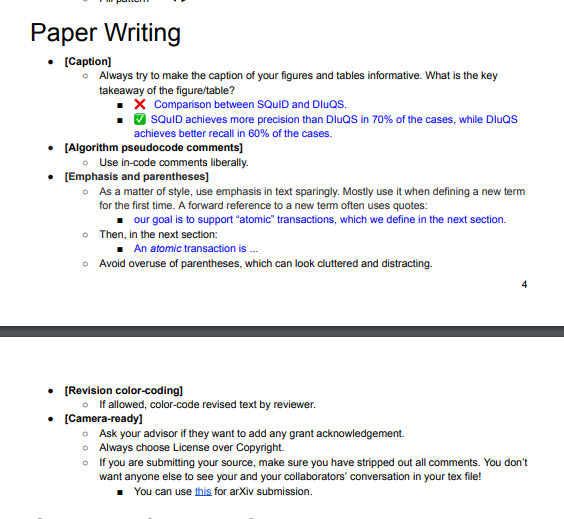
Even more
Non-breaking spaces
best practices - When should I use non-breaking space? - TeX - LaTeX Stack Exchange lists ALL the places where Knuth wanted people to put nonbreaking spaces, incl:
1)~one 2)~twoDonald~E. Knuth1,~2Chapter~12
Less obvious and not from him:
I~am
Also:
- before all cites, refs
- … and inlined equations
Citations
- ChatGPT says that citations should come before footnotes to prioritize the scholarly source over unimportant info.
- Citations go before the last period of the sentence, but within parentheses.
- Natbib reference sheet:
\citep{}aka\cite{}for inside Parenthesesthing *(Bob, 2043)*\citealp{}:sentence (as *Bob, 2032*, said)
\citet{}for citations inside Text:*Bob (2032)* says that ...\citealt{}for removes parentheses:*Bob 2032*(no comma!)
References (cleveref)
\cref>\autoref> vanilla\ref\usepackage[capitalise, nameinlink, noabbrev]{cleveref}is usually what I want- nameinlink makes
Figure ...linked as well, not just the number - noabbrev for
Figureinstead ofFig. - capitalise for uppercase by default, without it
\Crefdoes it manually.\Creffor beginning of sentence\crefotherwise is good karma regardless ofcapitalise
- nameinlink makes
- Appendixes will be called Appendix if you add
\crefalias{section}{appendix}before they start4 - Documentation:
Other bits
-
I sometimes write
and around ~50%forgetting that~is a nbsp — hard to catch when reading the text. -
As when writing code I like to add some
assert False(or a failing test) so that I know where I stopped the last time,\latexstopcompiling hereis a neat way to make sure I REALLY finis ha certain line I started but not finished. -
\clearpage(maybe a couple) for a new page -
Use the
xurlpackage, it’s it’s basicallyurlbut adds neat line breaks.\url{my-long-url-thingy.com}
Useful snippets
My favourite TODO command
% \newcommand{\TODO}[1]{{\color{magenta}\textbf{#1}}}
\newcommand{\TODO}[1]{{\color{magenta}#1}}
EDIT: the
todonotespackage is a thing! https://tug.ctan.org/macros/latex/contrib/todonotes/todonotes.pdf TODO use its much better optionsQuick environment for informal lists etc.
When starting a paper I usually add a first section with references/checklists, that gets deleted before submission. This makes it easy to write
% disables parindent, makes latex follow newlines
\newenvironment{META}{%
    \setlength{\parindent}{0pt}
    \obeylines
	\footnotesize % or not
}{%
    % group closes automatically
}
Sample usage:
\section*{Meta/TODO} \begin{META}
Things I need to remember:
- do x
- do y
--- and y1
--- and y1
- delete this section
\end{META}
\section{Introduction}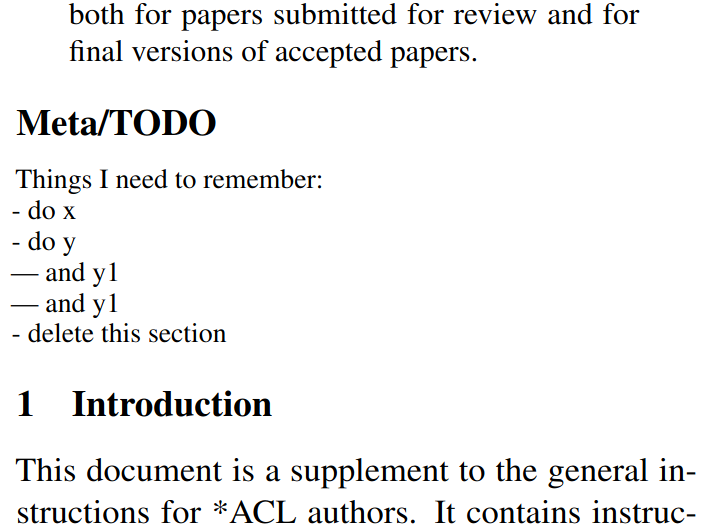
Same through groups
\def\TODO{\begingroup
\color{magenta}
\bfseries
}
\def\noTODO{\endgroup}

% then
\TODO here's my text, supports enumerations etc. inside as well! \noTODO Back to normal
Obeylines for simple newlines
(From https://tex.stackexchange.com/a/153540)
\bgroup\obeylines
Here line breaks
are respected.
\egroup
Here they
are not.
Auto titlecaps
(Don’t remember where from)
\usepackage{titlecaps}
\Addlcwords{the and but or nor for a an at by to in on with of}
\let\oldsubsection\subsection
\renewcommand{\subsection}[1]{\oldsubsection{\titlecap{#1}}}
% also section etc.
Saving space
TODO
% remove spacing before itemize
\usepackage{enumitem}

% https://tex.stackexchange.com/questions/23313/how-can-i-reduce-padding-after-figure
% \setlength{\belowcaptionskip}{-2ex} % default is 0
\setlength{\abovecaptionskip}{0pt} % default is 10

% don't change indent
\usepackage[skip=0pt, indent]{parskip}
Circled numbers
\usepackage{circledsteps}

% then for circled 3 do eg.
\Circled{3}
Make wide tables fit in the page
\begin{table*}[t]
\centering
\small
\begin{adjustbox}{max width=\textwidth}
\begin{tabular}{l  c c c c }
Make
mintedlistings use the same font for “Listing” in the caption\usepackage{caption} % This ensures lstlisting uses the standard caption style \captionsetup[lstlisting]{ format=plain, % Adjust labelfont and textfont to match your document class % Common options: bf (bold), sc (small caps), it (italic) labelfont=bf, textfont=normalfont, singlelinecheck=false }Colored boxes
\usepackage[many]{tcolorbox}
% ...
\begin{tcolorbox}[title=Box title,colframe=darkgray,colback=blue!5!white,arc=0pt,fonttitle=\bfseries]
\end{tcolorbox}
Footnotes in tables
Just use
\dag,\ddagand manually add to caption. DON’T FORGET ABOUT THEM!Symbols
- “The great, big list of LaTeX symbols”(PDF) with an ABSOLUTELY BRILLIANT COVER. h/t to overleaf
- LaTeX/Mathematics - Wikibooks, open books for an open world
Misc
- https://allanj.github.io/blog/2022/paper-writing/ is a page similar to this one, higher abstraction though. Many bits on condensing
TODO / more
- we’ll -> we will
- e.g., i.e.: always preceded by comma and followed by comma
- (in American English, as in ‘for example’, and ’that is’), but not British English.
- Somewhere I read that e.g. has commas if your list of examples has more than one, damn tha twould have been nice :(
-
punctuation - How to force LaTeX not to break the line after a hyphen “-”? - TeX - LaTeX Stack Exchange ↩︎
-
hyphenation - Allow line break, but without inserting a dash - TeX - LaTeX Stack Exchange ↩︎
-
[https://tex.stackexchange.com/questions/119513/cleveref-and-appendix-packages-appendix-referenced-as-section] ↩︎
-
German word Stehrümchen
Stehrümchen – Schreibung, Definition, Bedeutung, Synonyme, Beispiele | DWDS: “(oft dekorative) Dinge, die nicht gebraucht werden, die unbenutzt in der Wohnung stehen”.
I think Greulchen is basically the same thing.
-
Hyphens vs dashes vs en-dash em-dash minus etc
Hyphens vs dashes (em-dash, en-dash)
Previously: 220201-1625 German Bindestrich VS Minus, 231205-1311 Notes from paper review
Theory
Hyphen vs. Dash–What’s the Difference? | Grammarly is the source for what follows.
- Hyphen for
book-loving student: connecting two one-word entities- ‘dog-friendly hotel’, but ’this hotel is dog friendly’: hyphen only if the compound modifier comes before a noun (231201-1401 How to read and write a paper according to hackernews’s writing guide calls this “used as an adjective”)
take a five- or ten-minute break
- en-dash
–, width of a letterN, is a super-hyphen with extra glue for connecting entities that may be more than one word:pre–World War II buildings- formally - for time/page-number/score ranges
- an em-dash (width of an uppercase
M) is more artistic than technical. It’s a pause in a sentence, more than comma but less than semicolon or period. No rules about spacing around it as long as it’s consistent- for surprising information instead of
- parentheses
- explanatory or amplifying information
- sudden interruption, especially in dialogue
- two hyphens
--may get replaced by an em-dash in most programs (including TG)
- for surprising information instead of
- Fazit: the hard part in typography in en-vs-hyphen, creating an am-dash is trivial but it’s the less useful of all of them
- Maybe it’s my Ukrainian grammar interference, but I use it a lot in my sentence structure, especially in what maps to “explanatory or amplifying information”
Inserting them into things
How to make a long “-” in Markdown, i.e. the character “–”? - Stack Overflow for markdown
as unicode
-
–
—
HTML entities
Minus Symbol    −    −
En-Dash         –    –
Em-Dash         —    —
Smartypants
Markdown postprocessor, quoting documentation quoted in SO:
SmartyPants can perform the following transformations:

Straight quotes ( " and ' ) into “curly” quote HTML entities
Backticks-style quotes (``like this'') into “curly” quote HTML entities
Dashes (“--” and “---”) into en- and em-dash entities
Three consecutive dots (“...”) into an ellipsis entity
This means you can write, edit, and save your posts using plain old ASCII straight quotes, plain dashes, and plain dots, but your published posts (and final HTML output) will appear with smart quotes, em-dashes, and proper ellipses.
Let’s try:
- Smartypants: not in Hugo it seems ``curly’’, –, —, …
- HTML always works:
- minus-from-my-keyboard: -
- minus HTML: −
- n:–
- m:—
LaTeX
Surprisingly simple:
Hyphen: -
En-dash: -- /  \textendash
Em-dash: --- / \textemdash
Remaining questions
- Terminology;
- minus from my keyboard (-) vs
−(−) vs hyphen (?) vs dash (?) - The UniSearcher: Character Block 02000 - 020FF has 6 different dashes but oh well
Commitment (lol)
I’ll try to use all these correctly in all my written speech from now on because why not.
- Hyphen for